



Blog Shaoliv
About unusual things according to the author. About immortality. Ways to really fight old age. email: proxyda@hotmail.com
Creation Health & Immortality
| Address: planet Earth | Solar system| Milky Way galaxy | Virgo Cluster


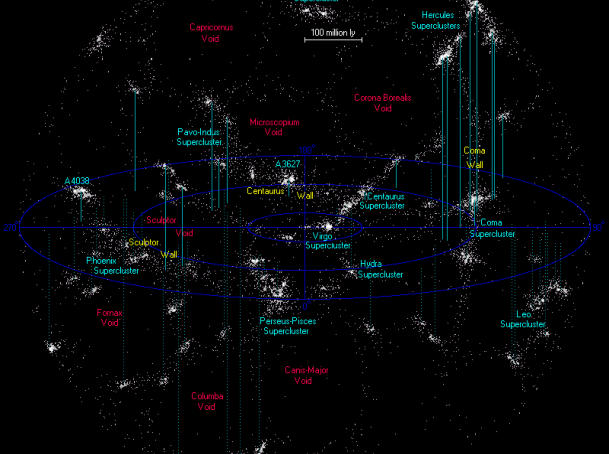
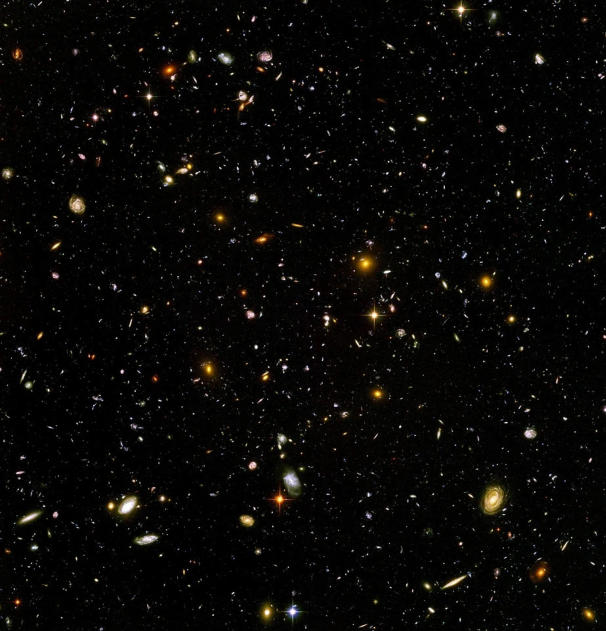
COSMOS Judging by the scale of the universe, we simply do not exist: Planet Earth is located in the Solar System, the Milky Way Galaxy, the Local Group of galaxies, the Virgo Supercluster, and beyond, larger superclusters. Our Milky Way galaxy is 100,000 light-years across. It contains 400 billion stars. All galaxies are moving toward the Great Attractor, 220 million light-years away! Our Universe is 13.8 billion years old. Its diameter is approximately 93 billion light-years. It contains at least 200 billion galaxies. Light from even more distant galaxies has not yet reached us. The number of stars is 2 x 10^23. This number is so great that it exceeds the number of grains of sand on planet Earth. Are we really alone in the Universe, despite this astonishing number of stars? All celestial bodies are accelerating, and therefore are subject to the force of gravity. I once read a book that discussed how, over the course of human history, the fuel used in stars has changed, from wood and coal to thermonuclear fusion. It's now believed that thermonuclear fusion occurs in stars, and no body can travel in a vacuum at the speed of light. All known methods of human flight exist in nature: wings, jet propulsion, and the rise of warm (light) air. Perhaps we're missing something, so I'll offer my own suggestions. 1. Physics reference books list the speed of light in various media: 123,845 km/sec in diamond, 199,803 km/sec in glass, and 299,704 km/sec in a vacuum. If we assume that the ether (vacuum) is a virtual fluid, then this fluid should have a cavitation effect, which forms a channel with another, less dense medium. In the deep sea, a special torpedo travels at 370 km/h, which is 5 times faster than normal speed. The distance to the nearest star is 4.2 light years. Dividing 4.2 by 5 yields 0.84 light years, which is also quite long. 2. In the "Technology" section, there's an article about using the Casimir effect for flight. Please read it. I think it's a viable idea. 3. Molecular kinetic theory states that increasing the temperature of a substance increases the kinetic energy of the molecules, causing particles to move faster. However, I couldn't find an explanation for the mechanism of energy transfer. From Newton's second law, we know that a body begins to accelerate when a force acts on it. I wrote above that ALL celestial bodies accelerate. After the Big Bang 13.8 billion years ago, the fragments didn't simply fly apart, but formed various vortices (proving that the vacuum is not uniform), from which celestial bodies emerged. But recently, it was discovered that the Great Attractor and Dark Energy exist, which further accelerate objects. So, in the macrocosm, the force causing acceleration is known—gravity. But what about the microcosm, for example, in a gas, where particles move continuously and, when heated, even increase in speed? I think that the waves (which ones and what frequency I don’t know yet) of the “vacuum” increase the amplitude and move the particle, similar to the wave motion of water. 4. I believe we need to look for areas of vacuum non-uniformity, "voids" in the vacuum. As far as I know, there's no generally accepted theory of vacuum. These "voids" will be the entrance to the vast labyrinth of outer space, through which more advanced alien users navigate. Therefore, once we find these "voids," we'll gain entry into the cosmic community. A normal mind treats a child very well. But an abnormal mind simply won't allow the child to be born. 5. We must learn to travel at speeds many, many times greater than the speed of light. This would result in an unusual kind of "time machine." Suppose we become interested in the era of Alexander the Great. We travel "instantly" to a point 2,350 light-years away. At this stage, options arise: 1. We build a massive telescope, point it at Earth, and observe Alexander the Great’s life from afar; 2. We travel "instantly" back to Earth—covering those 4,700 light-years—placing ourselves within that era so we can study it from the inside. I am aware of the "butterfly effect" and the "grandfather paradox." I agree that if such effects were to occur, history would take a different path, but "I" would not cease to exist, since I already am. A map of the superclusters and voids nearest to Earth A small patch of starry sky with galaxies. All the best to you!